
The Invited Philosopher
Melanie
This was the 20th dinner & philosophy event, and this time it took place at Melanie’s apartment in Brussels, where she cooked the meal and served a French wine selected especially for the night.
Menu
- Main course: Smoked tofu with oyster mushrooms in an Asian style sauce, served with basmati rice.
- Desserts: European Chocolates (Lindt, Ritter Sport)
- Drinks: Château Tour de Bigorre, Bordeaux 2022
The Philosophy
Our dinner discussion compared John C Lilly’s ego‑dissolving path toward “Satori”, with the tension in Apple TV’s Pluribus, where Carol Sturka’s fiercely individual ego resists joining a population bound by a collective “Oneness” hive mind.
A while ago, Melanie and I watched the series Pluribus (stylized as PLUR1BUS) about a world in which all humans, except for 13 people, Carol being one among them, have joined into “Oneness” due to a virus infection, acting in unison as one peaceful and happy “hive” mind. The Oneness humans share all memories and a single consciousness, losing their individuality, their personal desires, opinions, and goals, aka their “ego”. The series reminded me of John C. Lilly’s graph “Travel of Self”, shown in the figure below, and his research into altered states of mind, one of which, called Satori, is comparable to the state of the Pluribus people, which he defines as the “Happy Idiot State”.
In the graph, Satori is not mentioned, but it can be equated to Essence. In his 1971 Esalen lecture, the movement is shown as:
Lowest Satori = Ego → Essence = Highest Satori
Ego is the conditioned self. Essence is the unconditioned self. Satori is the realization that the self is not separate. Essence is a person’s unconditioned, original nature. Essence is what remains when the ego’s defenses, narratives, and survival strategies fall away.
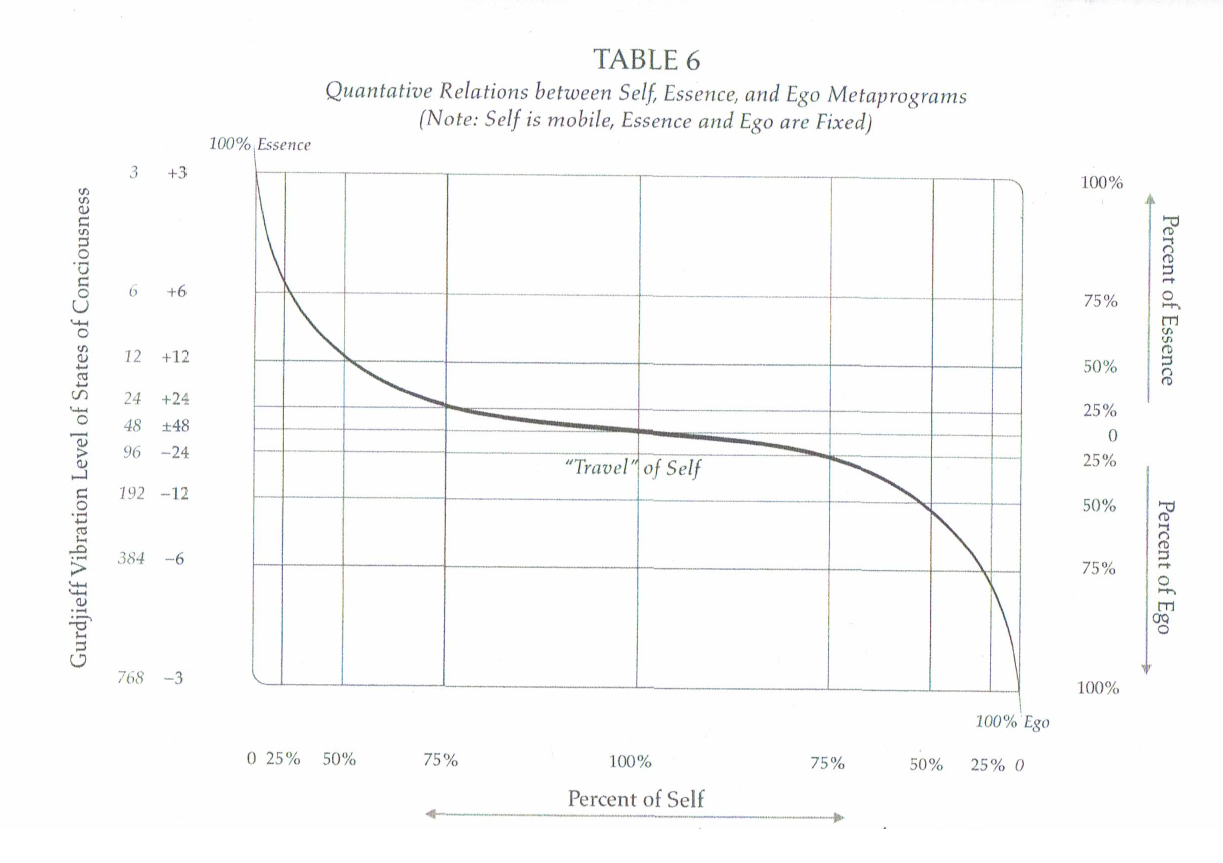
Lilly’s philosophy espouses that Satori is a desirable, happy state and that the ego limits our experience of happiness. In this 1971 Esalen lecture, he contends that ego reduction raises our energy vibrations (measured in the Gurdjieff scale) to a happy state and is necessary to attain Satori. This stands in contrast with the character of Carol Sturka in Pluribus, who resists joining the Oneness crowds and fights to retain her individual identity.
The Summary
In this 20th philosophy dinner, we discussed and compared John C. Lilly’s philosophy with the philosophical questions arising from the Pluribus series depicting the conflict between Carol Sturka, one of the non-infected characters, and the Oneness hive mentality of the infected humans. The series has provoked much philosophical discussion on the Internet, including a call for papers for a book on this website, which summarizes the Pluribus dilemma of choosing Ego over Oneness. Our focus was on the decision we would make if faced with the same choices as Carol Sturka.
Analysis
Pros & Cons of the Happy Idiot State
For many spiritual seekers and scientific researchers of consciousness and altered states, Satori is a desirable state. Lilly describes the various levels of Satori in his Esalen lecture. He equates Satori with Samadhi from the Yoga, Vedānta, Buddhism traditions. Both are states of profound unity in a universal consciousness. The Satori levels are vibrations or frequencies of energy wavelengths. Higher frequencies have shorter wavelengths, starting at 3 (Maximum Essence, No Ego) to the lowest vibrations at 768 or -3 (Maximum Ego, No Essence) in factors of 2. Lilly prefers to look at the levels as negative (ego territory) and positive (Satori territory).
Satori levels – from neutral to high vibrations
- Level ±48 is the neutral state, when a person is indifferent to what is happening and at ease.
- In Satori +24, people are happy and content with what they are doing, akin to “being in the flow”.
- In Satori +12, people are in a state of bliss that can be attained via psychedelic drugs, sex, and disciplined meditation, in which a person feels the energy of others and feels connected to them. It starts to resemble the Oneness of Pluribus in which all people are connected, have no individual ego, and are happy.
- In Satori +6, the person disappears in a profound mystical state, comparable to the contemplative union with the divine articulated by St. John of the Cross and St. Teresa of Ávila.
- In Satori +3, the person recognizes themselves as the Essence, and the same Essence as present in everyone else. This is the Oneness state in Pluribus. As Lilly notes, this Essence can “pilot” any human vehicle by checking the glove compartment for the instructions on how that vehicle thinks, feels, and runs its ego programs.
As an example, Lilly says in his lecture that most people attending are at 48; people who dislike his lecture are in -24; people who are hyper-enthusiastic and very attuned to his message are at +24. Levels +12, +6, and +3 are also encountered via hypnosis or in near-death experiences.
The Pluribus Hive
According to Lilly, Satori +12 is what he calls the “Happy Idiot State”, a state in which “you are happy like a child, with a happy idiot grin in your face, a state that our ego and our cultures do not condone in adults”. +12 is easy for a child, but as the child grows older and accumulates ego programs, it is more difficult to achieve. States above +12 are rarely attained, and we can only guess if the Pluribus hive resides in those states.
In Pluribus, all infected people share one consciousness that contains each other’s memories. They lose their individuality and cannot even say ‘I’. No matter what they are doing, they always smile or appear at ease. They live in the happy idiot state. Zosia is a main character who is among the infected people, and as the casting directors stated: “She had the impossible task of playing ‘the loveliest person in the world’ to offset Carol’s misery.” As Melanie recalled, in an early episode, Zosia appears dirty and disheveled yet smiling as she climbs into the cockpit of a massive Air Force One-like plane and flies it effortlessly, drawing on the memories of every pilot on earth. Using Lilly’s analogy of Satori +3, the Pluribus Oneness “essence” pilots the human vehicle (body) that belonged to Zosia, pre-infection. Zosia explains the hive to Carol, and through her, we learn the similarities to the Satori state.
Melanie pointed out that someone in +12, if given the option to stay in +12, would stay there, comparing it to the Pluribus scenario in which a non-infected person, like the Peruvian Indian girl, chooses to join the Oneness hive and, by joining, loses her ego and her ability to discriminate between the pros and cons of being a unique individual. In Pluribus, joining the hive appears non-reversible, but later episodes hint at a method that may bring people back to their individual identities. In real life, anyone visiting Satori +12 comes back to “reality” quite quickly and is consumed by the ego pulling them down to levels below +12.
Pros & Cons of the Ego Programs
Like Lilly explains, we are not referring to “ego programs” in the “ego trip” sense, nor are we referring to it using the psychoanalysis definition; instead, we refer to ego as “learned personal beliefs about ourselves”. The strength of the ego programming is measurable. It is possible to measure our own ego programming by how often we complain about anything and by how often we start a sentence with any permutation or mutation of these words: “I am a person who…, I always…, I never …, I know I’m good at…, I know I’m bad at…, I like…, I don’t like…” Any belief that gives us an identity and an opinion of who we are or a judgment on what others are, is the fabric of the ego. We also adopt Lilly’s definition of the ego’s “downer programs” because all ego beliefs (beliefs about oneself) bring people down (to low vibration states).
Lilly describes states driven by the ego program (Minute 40 in his lecture), ranging from -24 to -3.
Satori levels towards the ego’s low vibrations
- Satori -24 is the first negative state, in which the ego starts to produce negative emotions or “low energy vibrations.”
- Satori -12 is the opposite of the blissful state of +12. Lilly states in his lecture: “You are an idiot here, but you are an idiot who is in pain, who is in fear. This is where the psychotics exist.”
- Satori -6 is the opposite of +6, with a passive acceptance of the downer ego programs, just like in +6, there is a passive acceptance of the blissful state.
Here is another description by Lilly of Satori -24:
“The closest negative state to the neutral state is -24. It is where a person finds themselves when they have drunk too much alcohol. It is the first level of depression, the first level of self-castigation, the first level of paranoid fear. You can still carry on your job, but it is no fun. It is a burden.”
Carol’s Ego
Based on this scale, one may obseve that Carol lives in these negative states driven by her ego programming. Carol later reveals that her parents sent her to a conversion camp, a program aimed at forcing LGBTQ+ youth to change their identity, a traumatic experience that likely strengthened her ego defenses, a pattern seen in many people who, unable to move beyond their trauma, remain identified with a victimized self‑concept. Carol also feels insecure about her writing, and this insecurity is what Lilly would call a downer ego program.
Twice in the series, Carol’s rage unleashes epileptic‑like seizures across the entire connected population, killing thousands, which forces her to become far more cautious with her anger. It invites the question of how we might act if we understood that our own rage radiates outward into humanity, perhaps even manifesting as wars, violence, and the planet’s destruction. Carol Sturka is a perfect example of an egocentric, self-absorbed human. She exhibits clear signs of rage, anxiety, frustration, impulsivity, low self-esteem, a pattern of belittling others, and a deep fear of losing her sense of identity. Carol isn’t a happy person, and the truth is, she wasn’t any happier before the virus swept through the population. It’s tempting to imagine she’d find relief by joining the Oneness hive, but the show hints at a harder truth: there is an argument to be made for keeping our “uniqueness” even if it makes us unhappy.
Melanie noted that joining the hive would mean losing some essential emotional experiences, like the love we form through relationships, or the grief Carol felt after her partner died. Grief is an ego‑based reaction rooted in attachment and the mind’s resistance to a loved one’s absence. Is grief good? Is it a sign of love?
Lilly would argue that true love, the kind that is unconditional and unattached, can be found in Satori, or in the Pluribus case, in the hive. Moreover, he describes the ego states as painful states. In his lecture, someone asks whether pain, such as the “dark night of the soul”, is necessary. He does not believe it is.
Ego states can be intensely painful, as described in this lesson inspired by George Gurdjieff, which makes it all the more striking that anyone would cling to ego over Satori, the contrast we turn to next.
Non-Dualism and Why Leave the Hive?
Non‑dualism is the view that our apparent separation from others and the world, i.e. Dualism, is an illusion, and that reality is fundamentally one unified consciousness, as in the Pluribus hive. By the end of the series, we get a hint that those who joined the hive might eventually be restored to their individual selves, a thread the next season will almost certainly explore. Melanie and I ended up talking about what would drive someone to join the hive in the first place, and, if a path back exists, what would make someone choose to return to individuality.
Life can be a painful experience, often because of the automatic ego‑driven reactions and negative mental patterns most of us don’t even realize are running in the background. On the other hand, the suffering and experiences we have shape our individuality and make us feel special and unique, and people seem to “cherish” that.
It’s easy to justify wanting a temporary glimpse of Satori, non-dualism, or hive‑level consciousness, even out of curiosity, as long as we know we’ll return to our familiar ego self. There are, however, a few cases of humans who have reached Satori and stayed there. People in this condition are often called awakened or enlightened (for example, Eckhart Tolle or Yolande Duran‑Serrano). Their state is described as non‑dual because they no longer identify with the personal ego they present to the world; they experience themselves instead as part of a universal consciousness or energy. If this state brings permanent happiness, free of worry, lacking nothing, filled with love, and without personal desire, then why would anyone choose to leave it?
By definition, they wouldn’t.
However, we can also identify with Carol in her resistance to joining the hive and keeping her individual identity. Humans crave to be unique or special; their egos drive that need to stand out and find value in being different from others. Moreover, we value our free will and the ability to choose between different options. It seems more important than being happy. The choice is a personal choice. For spiritual seekers who have had a glimpse of Satori, the choice is easy; they will choose Satori. The rest, who are living with the ego program and have never experienced Satori, may choose ego pain, as long as it provides the experience of individuality.
Most people are dead by the time they are 30, which is when they are fully programmed.
― George Gurdjieff